
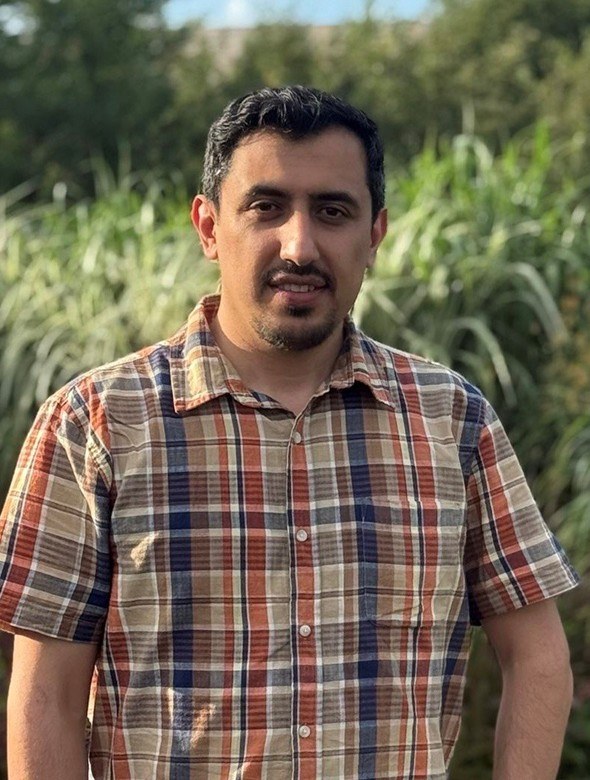
Saleh Rahimlou
- Postdoctoral Scholar
University Park, PA 16802
- Email sxr5998@psu.edu
- Office 734-373-9200
Areas of expertise
-
Microbial ecology and biodiversity
-
Plant pathology and plant–microbe interactions
-
Genomics, metagenomics, and multi-omics data analysis
-
Bioinformatics and computational biology
-
Phylogenomics and genome-scale evolutionary analysis
-
Microbial evolution and ecological dynamics
-
Fungal symbioses and soil/root-associated microbiomes
-
Mating system analysis in fungi
-
Computational marker design for pathogen diagnostics
-
Microbiome contamination analysis
-
Comparative genomics and microbial trait database development
-
Development of computational pipelines and analytical tools
Websites
Education and Job Experience
-
Post-doctoral fellow (07/1/2025 – Present). Department of Plant Pathology and Environmental Microbiology, Pennsylvania State University. PI: Prof. David M. Geiser
-
Post-doctoral fellow (10/1/2022 – 06/30/2025). Department of Ecology and Evolutionary Biology, University of Michigan. PI: Prof. Timothy Y. James
-
Ph.D. (2017-2022): Microbial Ecology. University of Tartu, Estonia.
Supervisor: Prof. Leho Tedersoo
Co-supervisor: Prof. Mohammad Bahram
-
M.Sc. (2012-2015): Plant Pathology with specialization in mycology. Sari Agricultural Sciences and Natural Resources University, Iran.
-
B.Sc. (2009-2012): Plant Pathology. Urmia University, Iran.
Areas of interest
My research focuses on fungal and bacterial biodiversity, plant pathology, and microbial evolution, leveraging high-throughput sequencing, (meta)genomics, and bioinformatics to explore the diversity, ecology, and evolutionary dynamics of microbes. I investigate root-associated fungi, including poorly understood lineages such as Entorrhizomycota, Archaeorhizomycetes, and Ceratobasidiaceae, generating genomic resources and performing phylogenomic analyses to clarify evolutionary relationships and the evolution of trophic strategies, including plant pathogenic, saprotrophic, and mycorrhizal lifestyles. I also study plant-associated microbes involved in nitrogen fixation and nodulation, particularly in phylogenetically distinct plant families such as Zygophyllaceae and Arecaceae, integrating metagenomics and multi-omics approaches to uncover the origins and mechanisms of nodulation in angiosperms. My work on Fusarium fujikuroi and Fusarium oxysporum species complexes combines genome-scale phylogenetics, mating system analysis, and computational marker design to investigate genome evolution, reproductive strategies, and pathogen diagnostics. Additionally, I explore environmental contamination in microbiome studies, examining fungi like Malassezia to understand their prevalence as human-derived contaminants in sequencing datasets. Across these projects, I integrate comparative genomics, multi-omics, and computational tool development to deepen our understanding of microbial ecology, evolution, and plant–microbe interactions.
Grants and scholarships
2023 – Travel award to attend and present at the Mycological Society of America annual meeting, July 30 – August 3, 2023, Flagstaff, Arizona, USA.
2023 – Funding resources for post-doctoral fellowship:
-
Gordon and Betty Moore Foundation, Developing Marine Malassezia as a model fungal symbiont, Grant No. 9343. Anthony Amend (PI).
-
National Science Foundation, DEB-SBS, PurSUiT: Discovery and phylogenetic analysis of chytrid fungi using cultures and single cells. DEB-1929738. Timothy Y. James (PI).
2022 – T1.1 Dora Plus short-term mobility grant
2021 – T1.1 Dora Plus short-term mobility grant
2020 – Proposal (WIP) ID: 506772. Bahram M. (PI), Cubeta M. (Co-PI), Rahimlou S., Tedersoo L., Ryberg M., Põldmaa K., Yagame T. Evolution of nutritional modes of Ceratobasidiaceae (Basidiomycota, Fungi). Joint Genome Institute (JGI). https://jgi.doe.gov/csp-2021-evolution-nutritional-modes-ceratobasidiaceae
2019–2020 – Dora Plus Action 1 – Study Mobility of Doctoral Degree Students (6 months) – Laboratoire de Recherche en Sciences Végétales (LRSV-CNRS) – Toulouse, France. “Identification of the bacterial symbionts associated with root nodules of Tribulus terrestris and Roystonea regia using molecular methods”
2017 – Dora Plus doctoral studies scholarship, Faculty of Science and Technology (2017-2021), Botany and Ecology. University of Tartu, Estonia.
Publications
-
Liyanage, Y. M., Kariman, K., Rahimlou, S., & Rengel, Z. (2026). Feremycorrhizal Fungus Austroboletus occidentalis Improves Growth and Nutrition of Diverse Crop and Pasture Species. Journal of Soil Science and Plant Nutrition, 1-16.
-
Gohar, D., Põldmaa, K., Pent, M., Rahimlou, S., Cerk, K., Ng, D. Y., ... & Bahram, M. (2025). Genomic evidence of symbiotic adaptations in fungus-associated bacteria. Iscience, 28(4).
-
Rahimlou, S., Amend, A. S., & James, T. Y. (2025). Malassezia in environmental studies is derived from human inputs. Mbio, 16(6), e01142-25.
-
Rahimlou, S., Moghadam, M.H., Gazis, R., Karlsen-Ayala, E., Bahram, M., James, T.Y., Tedersoo, L. (2024). Unveiling Root Nodulation in Tribulus terrestris and Roystonea regia via Metagenomics. Molecular Genetics and Genomics, 300(1), 9.
-
Myers, J., Schulz, F., Rahimlou, S., Amses, K., Simmons, D. R., Stajich, J. E., & James, T. (2024). Large DNA viruses in early diverging fungal genomes are relics of past and present infections. bioRxiv, 2024-01.
-
Rahimlou, S., Quandt, C. A., & James, T. Y. (2024). Metabolic Constraints and Dependencies Between “Uncultivable” Fungi and Their Hosts. In Fungal Associations (pp. 33-57). Cham: Springer International Publishing.
-
Tedersoo, L., Drenkhan, R., Abarenkov, K., Anslan, S., Bahram, M., Bitenieks, K., ... & Mikryukov, V. (2024). The influence of tree genus, phylogeny, and richness on the specificity, rarity, and diversity of ectomycorrhizal fungi. Environmental Microbiology Reports, 16(2), e13253.
-
Kariman, K., Rengel, Z., Rodica, P.E.N.A., Rahimlou, S., & Tibbett, M. (2024). The necessity to expand mycorrhizal boundaries: Including the fungal endophytes that possess key mycorrhizal criteria. Pedosphere, 34(2), 520-523.
-
Mikryukov, V., Dulya, O., Zizka, A., Bahram, M., Hagh-Doust, N., Anslan, S., ... & Tedersoo, L. (2023). Connecting the multiple dimensions of global soil fungal diversity. Science advances, 9(48), eadj8016.
-
Azadnia, A., Mikryukov, V., Anslan, S., Hagh-Doust, N., Rahimlou, S., Tamm, H., & Tedersoo, L. (2023). Structure of plant–associated microeukaryotes in roots and leaves of aquatic and terrestrial plants revealed by blocking peptide-nucleic acid (PNA) amplification. FEMS Microbiology Ecology, 99(12), fiad152.
-
Rahimlou, S., Moghaddam, M.H., Nezhad, A.M.H., Heidari, B., Bahram, M. (2023). A checklist and worldwide distribution patterns of macrofungi in Iran. Mycological Progress, 22(33), 33.
-
Kariman, K., Rengel, Z., Pena, R., Rahimlou, S., Tibbett, M. (2023). Response to “feremycorrhizal fungi: A confusing and erroneous term”: feremycorrhiza means ‘nearly mycorrhiza’; hence, it is a clear and correct term because the fungal partner has mycorrhizal traits and lineage. Soil Biology and Biochemistry, 108934.
-
Tedersoo, L., Loit, K., Agan, A., Rahimlou, S., Vask, A., Ariyan, M., & Drenkhan, R. (2023). MycoPhylo experiment: Towards understanding how mycorrhiza types and phylogenetic relationships affect soil biodiversity and functioning. Sustainable Forestry, 6(1).
-
Tedersoo, L., Mikryukov, V., Zizka, A., Bahram, M., Hagh‐Doust, N., Anslan, S., ... & Abarenkov, K. (2022). Global patterns in endemicity and vulnerability of soil fungi. Global Change Biology, 28(22), 6696-6710.
-
Soudzilovskaia N.A., He J., Rahimlou S., Abarenkov K., Brundrett M., & Tedersoo L. (2022). FungalRoot v.2.0 – an empirical database of plant mycorrhizal traits. New Phytologist, 235, 1689-1691.
-
Kariman, K., Moreira-Grez, B., Scanlan, C., Rahimlou, S., Boitt, G., & Rengel, Z. (2022). Synergism between feremycorrhizal symbiosis and free-living diazotrophs leads to improved growth and nutrition of wheat under nitrogen deficiency conditions. Biology and Fertility of Soils, 1-13.
-
Hosseyni Moghaddam, M. S., Safaie, N., Rahimlou, S., & Hagh-Doust, N. (2022). Inducing tolerance to abiotic stress in Hordeum vulgare L. by halotolerant endophytic fungi associated with salt lake plants. Frontiers in microbiology, 13, 906365.
-
Tedersoo, L., Mikryukov, V., Zizka, A., Bahram, M., Hagh-Doust, N., Anslan, S., ... & Abarenkov, K. (2022). Towards understanding diversity, endemicity and global change vulnerability of soil fungi. bioRxiv.
-
Tedersoo, L., Mikryukov, V., Anslan, S., Bahram, M., Khalid, A. N., Corrales, A., ... & Abarenkov, K. (2021). The Global Soil Mycobiome consortium dataset for boosting fungal diversity research. Fungal Diversity, 1-16.
-
Rahimlou, S., Bahram, M., & Tedersoo, L. (2021). Phylogenomics reveals the evolution of root nodulating alpha-and beta-Proteobacteria (rhizobia). Microbiological Research, 250, 126788.
-
Sayari, M., van der Nest, M. A., Steenkamp, E. T., Rahimlou, S., Hammerbacher, A., & Wingfield, B. D. (2021). Characterization of the Ergosterol Biosynthesis Pathway in Ceratocystidaceae. Journal of Fungi, 7(3), 237.
-
Põlme, S., Abarenkov, K., Nilsson, R. H., Lindahl, B. D., Clemmensen, K. E., Kauserud, H., ... & Tedersoo, L. (2020). FungalTraits: a user-friendly traits database of fungi and fungus-like stramenopiles. Fungal diversity, 105(1), 1-16.
-
Soudzilovskaia, N. A., Vaessen, S., Barcelo, M., He, J., Rahimlou, S., Abarenkov, K., ... & Tedersoo, L. (2020). FungalRoot: global online database of plant mycorrhizal associations. New Phytologist, 227(3), 955-966.
-
Tedersoo, L., Rahimlou, S., & Brundrett, M. (2019). Misallocation of mycorrhizal traits leads to misleading results. Proceedings of the National Academy of Sciences, 116(25), 12139-12140.
-
Tedersoo, L., Laanisto, L., Rahimlou, S., Toussaint, A., Hallikma, T., & Pärtel, M. (2018). Global database of plants with root‐symbiotic nitrogen fixation: Nod DB. Journal of Vegetation Science, 29(3), 560-568.
-
Rahimlou, S., Babaeizad, V., Bose, T., & Sayari, M. (2016). Determination of lignin-modifying enzymes (LMEs) in Hyphodermella species using biochemical and molecular techniques. Mycologia Iranica, 3(1), 57-63.
-
Rahimlou, S., Bose, T., Babaeizad, V., Sayari, M., & Tajick, M. A. (2015). Molecular data confirm the mitosporic state of Hyphodermella rosae (Phanerochaetaceae) as the pathogen of rosaceous fruits in northern Iran. Sydowia, 67, 189.
-
Mirhosseini, H. A., Babaeizad, V., & Rahimlou, S. (2014). Neofusicoccum parvum, agent of leaf spot on the new host Ginkgo biloba in Iran. New Disease Reports, 30.
-
Rahimlou, S., Babaeizad, V., & Sayari, M. (2014). First report of fruit spot of pomegranate caused by Colletotrichum gloeosporioides in Iran. Journal of Plant Pathology, 96(3).
Student supervision
Mrs. Yasodhini Liyanage
Project: Exploring the host plant range and functional mechanisms in feremycorrhizal symbiosis
Institute: University of Western Australia, School of Agriculture and Environment
Commencement date: 01 Jun 2022
Advisory panel:
Internal advisory panel members
• Prof. Zed Rengel
• Dr. Khalil Kariman
• Dr. Mingpei You
External advisory panel member
• Dr. Saleh Rahimlou
Peer review
Journal: Nature communications
Review date: 2023 Type: review Role: reviewer
SOURCE-WORK-ID: f6880c3b390dc2fcdc2dc3a192c42da8
Convening organization:
Springer Nature (London, GB)
Journal: Plant and Soil
Review date: 2022 Type: review Role: reviewer
SOURCE-WORK-ID: f9e9f140-e1e5-488f-a3ce-1e006bab2056
Convening organization:
Springer Nature (New York, US)
Journal: Soil Biology and Biochemistry
Review date: 2023 Type: review Role: reviewer
SOURCE-WORK-ID: e674bd7d-afde-4b34-b7bb-a844ccd542b7
Convening organization:
Elsevier, Inc. (New York, US)
Journal: Mycorrhiza
Review date: 2023 Type: review Role: reviewer
SOURCE-WORK-ID: e54ff0e7-dd69-4bb1-90b3-315cb8dd3761
Convening organization:
Springer Nature (New York, US)
Journal: Ecology and Evolution
Review date: 2024 Type: review Role: reviewer
Manuscript ID: ECE-2024-07-01534
Journal: Plant and Soil
Review date: 2024 Type: review Role: reviewer
Manuscript ID: PLSO-D-24-02368
NSF proposal no. 2444523
Title: Unearthing how wildfire behavior alters the composition and function of belowground microbial communities in mixed-conifer forests.
